Blind Spot Challenge the bookies' blind spot
One double a day · 50 places · Doors close Monday midnight
Every bookie has a blind spot. This challenge bets into it, once a day.

We are turning £100 into £5,000 with one double a day, placed where the bookies are not looking. You copy every bet.

One goal double a day, priced at 2.00 or better, in the leagues the bookmakers cannot be bothered to price properly. The stake is 5% of the bank, every day, so it compounds. Start with £100. The target is £5,000 by the end of May, and that is the floor, not the ceiling.

Doors close Monday 12th October, midnight UKFirst double goes out Tuesday

00
Days
:
00
Hrs
:
00
Min
:
00
Sec

Take one of the 50 places - £29 ›

One payment · covers the whole season to May · 30-day guarantee

50 places. First come, first served.

13 winning doubles in a row at his best. 3 losing days at his worst. Ten years of Ian's own records.

The climb · £100 to £5,000 Seven months · Oct to May
£100
£5 a bet
~15 wins
£200
£10 a bet
~15 wins
£400
£20 a bet
~15 wins
£800
£40 a bet
~15 wins
£1,600
£80 a bet
~15 wins
£3,200
£160 a bet
~10 wins
£5,000
£250 a bet

Every step is one doubling of the bank, and every step is the same height on purpose: at 5% stakes, each doubling costs about fifteen winning days, whether you are climbing from £100 or from £1,600. The stake under each figure is what one bet is worth once you are standing there. The plan, not a promise.

00 The ledger

The record starts on Tuesday night

Nothing to show you yet, and we would rather show you nothing than show you something invented. Row one gets written on Tuesday evening, when the first double kicks off. From then on every double, won or lost, goes in here the moment it settles, and the running bank underneath it moves with it. No quiet edits, no deleted losers.

0
Doubles placed
0
Won
0
Lost
£100
Bank right now
DateThe doubleOddsStakeResultBank
Tue 13 OctIan's first double of the challenge2.00+£5.00pending£100.00
Starting bank£100.00

If you are in before Monday midnight, this row has your name on it too. Same double, same price, same £5.

01 From two punters who got bored of losing

Last season Ian paid for a goals tipping service. It was so bad he started his own.

Hi,

I will come back to that in a minute, because it is the reason this page exists. First, a question.

Have a think about the last £100 you put into a betting account.

Where did it go? Chances are it went the way most hundreds go: split across a Saturday, most of it on the televised games, a couple of bets picked because the price looked big rather than because the bet looked right. By teatime it was gone, and the only thing you had to show for it was a vague plan to deposit another hundred next week.

That is not a losing streak. That is a bank with no job to do. Money that arrives with no plan, no staking, no target and no exit gets spent, every single time.

Now, Ian.

Ian lives in England and has bet football for well over a decade. For the first part of that he did what everyone does: match odds, the big leagues, the games on the telly. He was decent at it. His profits never grew. He was winning and losing in the same small circle, year after year, and could not work out why.

Two things changed it, and they are the two things this whole challenge is built on.

The first was learning to manage a bank. Not picking better, staking better. A fixed percentage of the bank on every bet, recalculated every day, so winners made the next bet bigger and the bank compounded instead of treading water.

The second was noticing where the bookmakers were lazy. The televised leagues are priced by the bookmaker's best people and corrected within minutes by thousands of sharp bettors. There is nothing left in those prices. But the goal markets in a Norwegian second-tier game on a Tuesday night? Those are set by a model, barely watched, and often simply wrong. Ian has been exploiting that for more than ten years, one double a day, and telling nobody.

Then last season he did something he had never done before. He paid for a goals tipping service, to see how the professionals did it.

His word for it was abysmal. The bank dipped from the first week and never showed a sign of recovering. Obvious games, short prices, no staking plan worth the name. He stuck with it longer than he should have, watched the bank go 40% down, and gave up.

What got to him was not the money. It was realising that other punters, people like he used to be, were paying for that and thinking it was what a tipping service looked like.

So here is the honest answer to the question you should be asking: if his method works, why is he selling it instead of quietly betting it with a bigger bank? Because he does bet it with a bigger bank, and you will see his slips further down. And because he knows exactly what it is to be a struggling punter, he has seen the garbage being sold to them, and he knew he could do better. That is the whole origin of this. Not a marketing plan. A bloke who was annoyed enough to prove it in public.

It is also why the price is £29 for the whole season and not £29 a month. He is not trying to get rich off fifty people. He wants a small group who will follow it properly, have some fun with it, and hopefully be looking at £5,000 of profit by May.

I am Stephen. I have been in and around betting for twenty-five years, I run this site and answer the support emails, and I am putting my own £100 on the same doubles, at the same time, as you. Ian picks the bets. I make sure you get them.

Here is what we are doing, in one paragraph.

One bank of £100. One double a day, built from goal markets, in the leagues the bookies price worst, and never sent unless it prices up at 2.00 or better. The stake is 5% of the bank, recalculated every single day. Seven and a half months, from Tuesday 13th October to the end of May. The minimum target is £5,000, and if we get there early we do not stop. Fifty people, maximum, for £29.

Now the part most sales pages would bury, so I will put it near the top instead.

Ian has never sold a tip. He has never run a service. Until last year he had never even thought about it. This is the first time he has let anyone in, which cuts both ways and you should weigh both sides.

The awkward side: there is no years-long public record to go and check, because he has never been public. Anyone telling you they have verified ten seasons of his results would be inventing it, and we are not going to.

The side that should interest you: you are getting a private method at the exact moment it stops being private. Not a tipster on his fourth relaunch, with a results page that starts conveniently after the bad run. A bloke who has been quietly doing this for himself for a decade, opening the door for the first time, with everything from bet one published in front of fifty people who are all watching.

Sold already? Skip to the order form ›


02 Why the edge exists

The bookies have a blind spot, and it is enormous

Every sceptic should ask the same question of any tipster: if this works, why has the bookmaker not priced it out? Here is the honest answer, and it is the reason the challenge has the name it has.

Because the bookmaker is not really looking.

Think about where the money goes on a Saturday. The Premier League. The Champions League. Whatever is on television. Those markets take enormous amounts of money, and two things happen as a result. First, the bookmaker puts his best traders on them, because an error there costs him a fortune. Second, thousands of sharp bettors hammer any price that is even slightly wrong, and it moves within minutes. By kick-off, a Premier League goals line is about as accurate as a betting price ever gets. There is no edge left in it for you, or Ian, or anyone.

Now think about a second-tier game in Finland that takes a tiny fraction of that money on a Thursday night.

Nobody is betting it, so nobody is correcting it.

Where the money and the attention go

Premier League
Champions League
La Liga, Serie A, Bundesliga
The Championship

Where Ian goes

League One and League Two
Spanish Segunda, French Ligue 2
Denmark, Norway, Finland
Dutch lower divisions
Scottish lower leagues
Iceland

Schematic, not measured. The point is the shape: the traders, the television and the sharp money all crowd the top. The prices at the bottom are set by a model and left alone, and the goal markets underneath the match-odds market get looked at least of all.

What low liquidity actually does to a price

  • The pricing is more automatedA market that might take a few thousand pounds all week does not justify a specialist trader watching it. It gets priced largely by model, with far less human scrutiny than a televised game.

  • There is no sharp money to correct itA wrong price only moves when somebody bets it. In a quiet market there is nobody to do the correcting, so an error can sit there untouched right up to kick-off.

  • The information is unevenly spreadA striker missing, a pitch that plays slow, a side resting players before a cup tie. In a big league that is on every front page within minutes. In a quiet league you have to go and find it, and almost nobody can be bothered. Ian can.

  • Goal markets get the least attention of allEven in a small league, the match-result market gets priced first. The over and under lines underneath it are an afterthought, and an afterthought is exactly where a mispriced number hides.

Ian's hunting ground

He bets anywhere in the world where the price is wrong, but these are the leagues that come up most. You will see fixtures on the slip you could not place on a map. That is the point.

Brazil, Iceland, Norway, Finland, Denmark, the Spanish Segunda, French Ligue 2, the Dutch lower divisions, English League One and League Two, the Scottish lower leagues, Indonesia, the Korean lower tiers, the Czech lower leagues, and anywhere else the number is wrong.

If you recognised every team we bet, we would be taking the same corrected prices as everybody else, and there would be no reason for this challenge to exist.

Being straight with you about the trade-off: in quieter markets the odds can move once money arrives, and some bookmakers set lower limits on them. At the stakes a £100 bank is placing, neither of those will trouble you for a long time. We tell you now rather than letting you discover it in month four.

03 One slip, two legs

One double a day. Never below 2.00.

Not accumulators. Not a list of eight bets to pick through. One slip, two legs, both from goal markets. Ian does the research the night before, double-checks it in the morning, and sends one double. That is the entire daily output, and it is deliberate: one well-researched bet a day beats six guesses.

Goals are the one thing in football you can model properly, because goals are what every team is built to score and every team is built to stop. Answer the question of how many goals a game is likely to produce, and you can take your pick of the goal markets:

Over 2.5 goals

Three or more. The open games.

Both teams to score

Both sides find the net.

Over 1.5 goals

The safer floor under a scoring game.

Under 3.5 goals

The ceiling on a tight one.

Team goals

One side's total, not the match.

And the rest

Whichever line the game actually points at.

Why a double, and why 2.00

A single goal bet at 1.45 is a slow way to grow a hundred quid. Put two of those legs together and the price multiplies: two selections Ian is confident in, at prices that look dull on their own, combine into one bet at 2.00 or better.

The slipPrice
Leg oneA goal market in one match1.45
Leg twoA goal market in another1.45
The double2.10

An illustration of how the pricing works, not a selection we are advising.

2.00 is a rule, not a preference. If the two legs do not combine into at least evens, the bet does not go out. Ian is not chasing big prices either: most doubles land a little above 2.00, not miles above it. The aim is simply that every winning bet at least doubles what you put on it, because that is what makes the next part work.

04 The part most punters never understand

Growing £100 into £200 takes exactly as long as growing £5,000 into £10,000

Read that again, because it is the single most important sentence on this page and almost nobody who bets has ever had it explained to them.

Here is the staking rule. Every day, the stake is 5% of whatever the bank is that morning. Day one, the bank is £100, so the stake is £5. That is the only rule. There is no chasing, no doubling up after a loser, no "recovery" stake. Five percent, every day, of whatever is there.

Now watch what that does.

A winning double at 2.00 pays back the stake and the same again. So a £5 bet wins £5, and the bank goes from £100 to £105. Tomorrow's stake is 5% of £105, which is £5.25. Win again and the bank is £110.25, and the stake is £5.51. Every winner makes the next bet bigger, automatically, without you doing anything.

Fifteen winning days at 5% and the bank has doubled. £100 has become £200 and the stake is £10.

Here is the bit that matters. Imagine the bank is not £100 but £5,000. The stake is 5% of that, which is £250. A winner adds £250, and the bank is £5,250. Tomorrow's stake is £262.50. Fifteen winning days later it has doubled, to £10,000. Same fifteen days. Same percentage. The only thing that changed is the size of the number.

Think of it as a pay rise. A 5% rise on £20,000 is £1,000. A 5% rise on £100,000 is £5,000. Nobody worked harder for the second one, it is just 5% of more. That is exactly what your bank is doing: the method never changes, the 5% is just 5% of a bigger number. Which is why the chart looks flat for weeks and then goes vertical, and why the last month of the challenge is worth more than the first five put together.

And when a double loses? The bank drops by 5%, tomorrow's stake is 5% of the slightly smaller bank, and one winner at 2.00 puts you back within pennies of where you were. Anything above 2.00, which is where most of Ian's doubles land, puts you ahead. You are never more than one win away from recouping a loser. That is the whole reason the 2.00 rule exists.

Press the buttons. Both banks move together, every time.

Bank A · started at £100

£100.00

Today's stake (5%): £5.00

progress to double0%

Bank B · started at £5,000

£5,000.00

Today's stake (5%): £250.00

progress to double0%

Winning days 0  ·  Losing days 0

Doubles are priced at exactly 2.00 in this demonstration. Ian's real doubles are usually a touch higher, which helps. Losing days are real and you should add some: the point is not that it never loses, it is that both banks always move by the same percentage, whatever their size.

£5,000 is the floor, not the ceiling

The target is £5,000 by the end of May. If results go to plan it arrives before then, and when it does, nothing changes. Ian keeps sending one double a day, the stake stays at 5%, and the bank keeps compounding until the final whistle of the season. You could walk away with a great deal more than the target. We put £5,000 on the page because it is the number we are prepared to be judged against, not because it is where we intend to stop.

Every bet is tracked and calculated for you

You never work any of this out yourself. Ian does the research, builds the double, checks the price, and we calculate the exact stake for the bank. The moment a result is in, it is logged and the bank is updated, after every single bet. Your email gives you the two legs, the price and the stake. If you can copy a number into a betslip, you can run this. That is the whole job on your side.

05 Everything that lands in your inbox

What you get for your £29

  • One double a day, emailed before 10.30amBoth legs, the combined price, and the exact stake for your bank size, to the penny. Before 10.30am UK on weekdays, earlier at weekends because the cards kick off sooner, and the night before if the game is an early kick-off. You will never be rushing.

  • Placeable at any bookmakerEvery bookmaker carries the leagues we bet, and we check the main ones have the double before it goes out. No special account, no obscure firm to sign up to, no app you have never heard of. Whatever you already use will take these bets.

  • The stake calculated for you, daily5% of the bank, worked out fresh every morning and printed in the email. Nothing to calculate, nothing to guess.

  • Every result tracked and the bank updated after every betYesterday's result at the top of every email, the running bank, the full ledger on the site. Winners and losers, no quiet edits.

  • Two of us answering your emailsEvery message comes to me, and if it is one for Ian he reads it and replies himself. Fifty members is the number we can do that for properly, which is why it is fifty.

  • Seven and a half months of footballFrom Tuesday 13th October to the end of May. 231 days, and a double on almost every one of them, around 220 over the season. There is football somewhere in the world every day, but on the rare day there is not enough of it to find a double worth sending, we tell you, and nothing goes out.

It takes about two minutes a day. Open the email, place the double, get on with your life.

06 What we can and cannot prove

The honest version of the receipts section

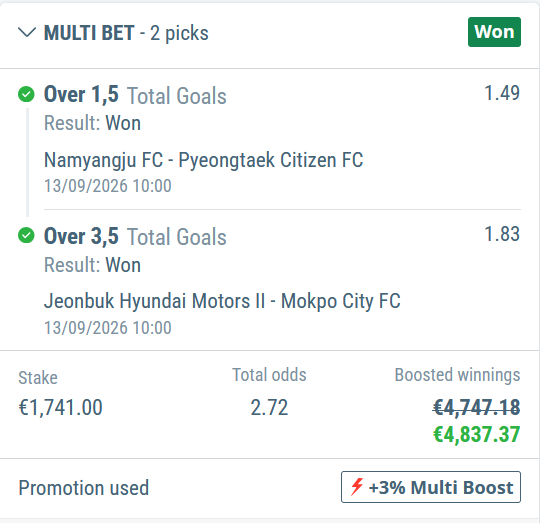
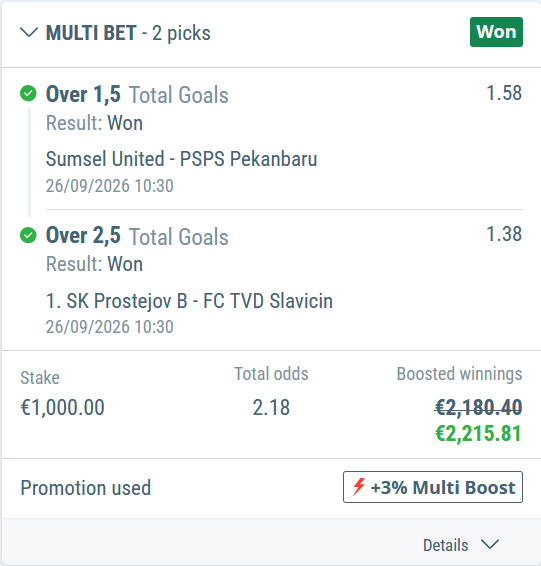
This is where a tipping page normally shows you two years of green rows and a five-figure balance. We cannot, because Ian has never run a service and there is no public history to point at. What we can show you is what his bets actually look like. Here are three of his own slips from September, straight out of his account, exactly as they settled.
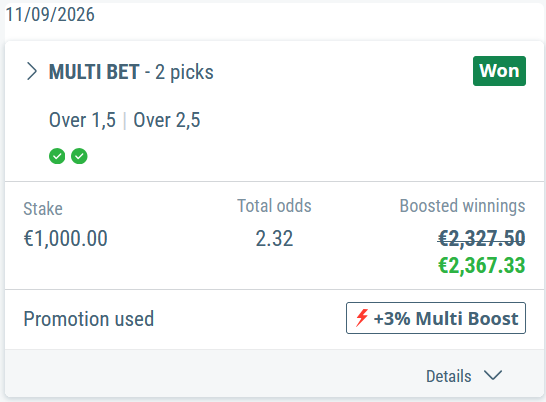
Winning two-leg multi bet, 11 September 2026: Over 1.5 goals and Over 2.5 goals, stake 1,000 euros at combined odds of 2.32

Fri 11 Sept 2026

Over 1.5 goals + Over 2.5 goals. Two different matches, one slip.
Odds 2.32 · Result Won

Winning two-leg multi bet, 13 September 2026: Over 1.5 goals in Namyangju v Pyeongtaek and Over 3.5 goals in Jeonbuk Hyundai Motors II v Mokpo City, stake 1,741 euros at combined odds of 2.72

Sun 13 Sept 2026

Namyangju v Pyeongtaek, over 1.5. Jeonbuk II v Mokpo City, over 3.5. Korean lower tiers.
Odds 2.72 · Result Won

Winning two-leg multi bet, 26 September 2026: Over 1.5 goals in Sumsel United v PSPS Pekanbaru and Over 2.5 goals in SK Prostejov B v FC TVD Slavicin, stake 1,000 euros at combined odds of 2.18

Sat 26 Sept 2026

Sumsel United v PSPS Pekanbaru in Indonesia, over 1.5. Prostejov B v Slavicin in the Czech lower leagues, over 2.5.

Odds 2.18 · Result Won

About those stakes

You will have noticed Ian is putting a thousand euros and more on a single double. Nobody in this challenge is betting at those stakes, and you should not either. Those are his own stakes, from his own bank, built up over more than a decade of doing exactly this. He uses a European bookmaker, which is why the slips are in euros.

The challenge starts at £5 a bet. That is the entire point of it. You are not copying Ian's stake, you are copying Ian's bet, and letting the 5% rule grow your own bank from £100 the same way his grew from wherever it started. His slips show you where the road goes. The challenge is about walking it from the beginning, one double at a time, and letting the bank build itself.

Look at the fixtures, because they are the real proof on this page. A third-tier game in Indonesia. A Czech reserve side. Two Korean lower-league matches on a Sunday morning. If you wanted evidence that the blind spot is real and that Ian genuinely bets into it, that is three slips' worth. Not one of those games had a specialist trader watching the goals line.

Three winning slips are three winning slips. They are not a track record and we are not pretending they are. He has losing ones too, and you will see those in the ledger the same day they happen. What these show is the shape of the bet: two goal-market legs, an unfashionable league, a price above 2.00, real money on it. That is what will land in your inbox every morning.

The small "multi boost" on each slip is a promotion his bookmaker runs on doubles. The odds quoted above and in the daily emails are the plain, unboosted prices.

From Ian's own records: a best run of thirteen winning doubles in a row, and a longest losing run of three days. Those are his numbers from his own tracking, not something we have audited, and we are telling you that plainly so you can weigh them accordingly.

And this is the part that matters more than any screenshot: from Tuesday 13th October the record is built in public, in front of you, from bet one. Every double published, settled and added to the running bank, including the losers, on the same day.

Nobody in the group has a head start. There is no historical record to argue about, because the record starts the day you join it. If it goes badly in week two you will read about it from us before you read about it anywhere else, and you will still be inside the 30 days.

Seen enough? Jump to the order form ›

07 Read this bit twice

What this is not

It is not a guarantee. Nobody can promise you a profit on football, and anyone who does is lying to you. £5,000 is the target we are chasing and the number we measure ourselves against. It is not a number we can hand you.

It is not instant. A £100 bank grows slowly at the start because the stakes are small at the start. The first month will look unremarkable. That is not the method failing, it is what the left-hand side of a compounding curve looks like. The people who do well here are the ones still placing bets in April.

It is not risk-free. At 2.00 and up you will have losing days, and you will have runs of them. Ian's records say three in a row is the worst he has had. Plan for worse than that and you will never be surprised. The 5% rule means no single day, and no single bad week, can do serious damage to the bank.

It is not for money you need. A hundred pounds you can afford to lose entirely. If that is not what this is, please close the page and spend it on something better.

What it is: one properly researched double a day, at a price worth taking, in the markets where the prices are softest, with the staking done for you and every result published, for £29.

08 Take your seat

Join the Blind Spot Challenge

One payment of £29. It covers every double from Tuesday 13th October to the end of May, and there is nothing else to pay, ever. Fifty places maximum, because Ian wants to work closely with the people following him, and when they are gone this page comes down.

Blind Spot Challenge50 places
Starting bank£100 (£50 minimum)
Every betOne goal double
Minimum price2.00
Stake5% of bank, daily
In your inbox by10.30am UK
Runs13 Oct to 31 May
Sign-up closesMon 12 Oct, midnight
Minimum target£5,000
£29
Founding price · one payment · no renewals
Yes - start my £100 bank ›

Secure checkout · instant access · 30-day guarantee

Doors close Monday midnight · first double Tuesday evening
220+
Doubles, one a day
13p
Per bet, researched and staked
<6
Of your own £5 stakes

£29 for around 220 doubles works out at thirteen pence a bet. Your first stake is £5, so the entire season of research costs less than six of your own bets. One losing acca on a Saturday costs more than this does.

£29 is the founding price for this first group of fifty. Once the record is public and the season is underway, it will not be £29 again.

30Day
Guarantee

Test the whole thing without risking a penny

Here is how to join with zero risk, and we mean zero. Join today. From Tuesday the doubles start arriving. For the first two or three weeks, do not put a single pound on them. Paper-trade instead: write each double down, note the price and the £5 stake, settle it yourself that evening, and run the bank on a scrap of paper or a spreadsheet. Within a fortnight you will know exactly what this service is and exactly what it does to a bank.

If at any point in the first 30 days you decide it is not for you, send one email and the £29 comes back in full. Day three, day twelve, day twenty-nine, it makes no difference. No forms, no questions, no argument, no hard feelings.

So the only thing you can lose by joining is the two minutes a day it takes to read an email. The £29 is protected for a month, and your betting bank never has to leave your pocket until you have watched the method work in front of you.

We would not write that paragraph if we expected you to use it.

09 Straight answers

Questions people ask before they join

Is it really just one bet a day?

One double, two legs, both goal markets, on about 95% of days from Tuesday 13th October to the end of May. No singles, no trebles, no accumulators, no "bonus bets". There is football happening somewhere in the world every day of the year, but now and again a day comes up with so little of it that nothing qualifies. On those days we tell you there is no bet rather than sending one for the sake of it.

Why do I not recognise any of these leagues?

Because that is where the prices are worth taking. Big televised leagues get priced by the bookmaker's best people and corrected within minutes by everyone else betting them. Quiet leagues take a fraction of the money, get far less scrutiny, and the goal markets underneath them get less still. That is the blind spot, and it only exists where nobody is looking.

How does the staking work, exactly?

Five percent of the bank, recalculated every morning, to the penny. Start with £100 and the first stake is £5. Win at 2.00 and the bank is £105, so tomorrow's stake is £5.25. Lose, and it is 5% of the slightly smaller bank. No rounding to the nearest pound, no chasing, no doubling up, no recovery stakes. The email tells you the exact number, you place it.

Do I really only need £100?

£100 is the recommended bank and the one the challenge is tracked on. You can start with as little as £50 if you like, your stakes will simply be half the size, and the percentages work exactly the same. You can also start with more. Whatever you put in, the bank only ever risks 5% of itself on any one day.

What happens when the doubles lose?

They will. The bank drops by 5%, the next stake is 5% of the slightly smaller bank, and one winner at 2.00 or better puts you back where you were. Ian's records show three losing days in a row as his worst run, but you should plan for worse than that so you are never surprised. The staking rule means even a bad week cannot do serious damage.

What time do the bets arrive?

Before 10.30am UK on a normal day, earlier at weekends because the cards start sooner, and if the game is an early kick-off, the night before. Some of the leagues we bet play in the Asian morning, which is the UK morning, so those doubles go out the evening before. You will always have the bet well ahead of kick-off.

Which bookmaker do I need?

Any of them. All the bookmakers carry the leagues we bet, and before a double goes out we make sure the main bookmakers have it. You do not need to open anything new. Shopping around will get you a slightly better price now and again, but it is not a requirement.

Will the bookmaker restrict my account for winning?

No. This gets talked about far more than it happens. Account restrictions are mostly a problem for people doing matched betting and arbitrage, where the bookmaker can see exactly what you are up to. In Ian's experience you need to be taking a serious amount of money off them, consistently, before anyone takes an interest. A £100 bank placing one double a day is nowhere near that, and will not be for a long time.

Has Ian run a tipping service before?

No. This is the first one. He has bet this way for himself for more than ten years and never sold a selection to anyone. That is the honest answer, and it is the reason there are only fifty places and the reason every single bet gets published from day one. If a long public track record is what you need before you part with money, this is not the service for you yet, and there is no hard feeling in that.

Why only fifty people?

Ian wants to work closely with the people following him, and fifty is the number two people can genuinely look after. It is also his first time running anything publicly, so we would rather do it properly for a small group than badly for a big one.

What if we hit £5,000 early?

We keep going. Nothing changes: one double a day, 5% of the bank, until the end of May. £5,000 is the minimum we are prepared to be judged against, not the point where we stop.

What happens if I miss a day?

Nothing dramatic. You pick the next one up and the staking adjusts to your bank, not ours. Your ledger is your ledger.

Is this a system I have to learn?

No. The research, the pairing, the price check and the stake are all done before the email is written. You copy two legs and a number into a betslip.

What happens the moment I pay?

You land on the members page, enter your name and email, confirm the list, and the welcome email arrives with everything in it. Then you wait for Tuesday morning like everyone else, when the first double arrives before 10.30am for that evening's games.

Is there a monthly fee?

No. £29 once, covers everything to the end of May, nothing else to pay.

10 Talk to us

There are two of us, and we answer

If something is not clear, ask before you buy. Every email comes to me, and if it is one for Ian he reads it and replies himself. We would far rather answer a question now than refund you in a month.

Support

support@blindspotchallenge.com

Read by both of us. Replies the same day, usually within a few hours.

Email us ›

Before you buy, after you buy, three months in when you have a question about a stake: same address, same two people.

Good luck,
Ian and Stephen Blind Spot Challenge · the bookies' blind spot

P.S. The whole thing rests on two ideas. The bookies are lazy where nobody is watching, and 5% of a bank is 5% whether the bank is £100 or £5,000. Ian handles the first one. The arithmetic handles the second. You handle copying a number into a betslip.

P.P.S. Sign-up closes Monday 12th October at midnight. The first double goes out Tuesday morning, before 10.30am, for Tuesday evening's games. Join before the deadline and you are in from bet one, on the same bank and the same stake as we are. Take a place here.

Start your £100 bank

Fifty places. £29 for the whole season. Every double published from the first one.

Take one of the 50 places ›

One payment of £29 · 30-day guarantee